Japan Air Lines Flight 1628
In their own words
“most unexpectedly two spaceships stopped in front of our face, shooting off lights. The inside cockpit shined brightly and I felt warm in the face”
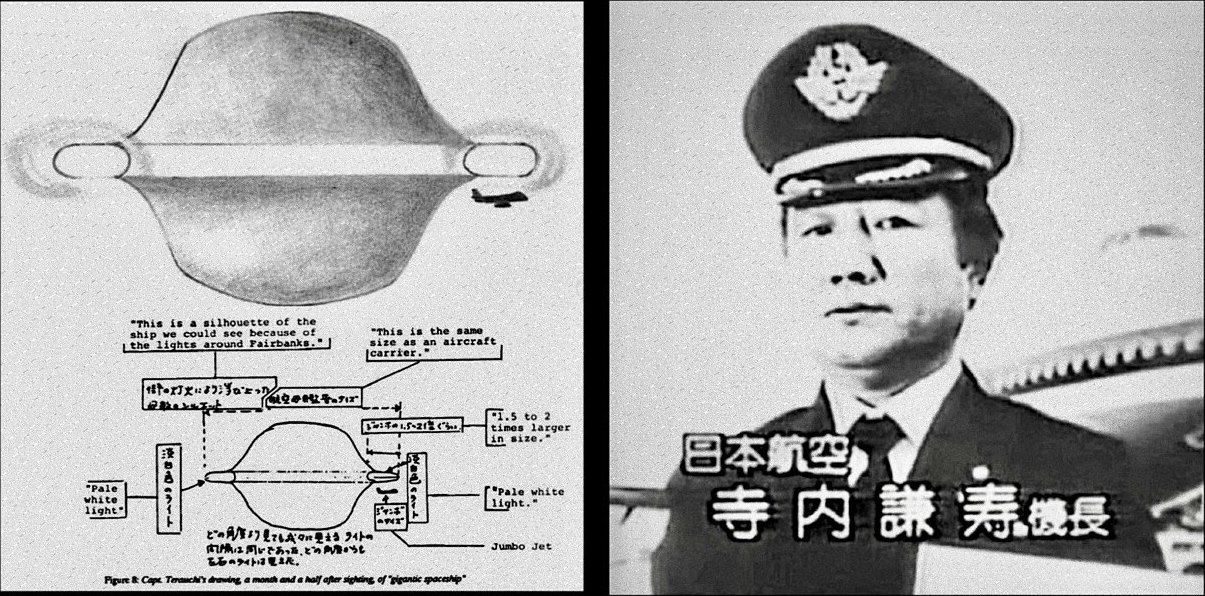
JAL 1628 was a Boeing 747 cargo flight from Reykjavik to Anchorage, carrying Captain Kenju Terauchi, First Officer Takanori Tamefuji and Flight Engineer Yoshio Tsukuba. The FAA documents spell these names variously, e.g. "Takonori", "Tsukuda" and "Yoshie Tsukuba". At about 18:19 AST (02:19 UTC) the crew reported unidentified traffic with lights pacing the aircraft over eastern Alaska. They reported it on the aircraft's own weather radar, and both Anchorage Center (ZAN) and the military Regional Operations Control Center (ROCC) saw intermittent primary returns near the 747. The encounter lasted about 30 minutes in the ATC chronology; the crew put it at about 50 minutes. A United flight and a USAF C-130 vectored to look saw nothing but the JAL aircraft. The FAA Alaskan Region interviewed the crew that night and again in January 1987. On 5 March 1987 it released a large documentary package (NTIS PB87-184206) and said the second radar target was a split ("uncorrelated primary and beacon") return from the 747 itself. It said it was "unable to confirm the event" and did not try to say what the crew saw. Primary documentation is unusually rich: ATC transcripts, controller statements, radar printouts, interview transcripts, and the captain's written statement and drawings.
Evidence, in date order (5)
- Nov 1986Controller Samuel Richwitnesssaw a radar return where the pilot reported traffic and asked about a scramble Controller personnel statements (733667-001-018)
- Nov 1986Elmendorf AFB ADC radarsensor datahad the JAL and an occasional primary target Alert report and FOIA routing (733667-001-025)
- 18 Nov 1986Military ROCC radarsensor dataprimary returns near the 747 and a 'flight of two' ZAN chronology memo (733667-001-012)
- 18 Nov 1986First Officer Tamefuji and Flight Engineer Tsukubawitnesscrew interviewed by the FAA on landing Crew interview notes (733667-001-005)
- 19 Nov 1986Controller Carl Henleywitnesssaw primary returns where the crew reported traffic Controller personnel statements (733667-001-018)
How plausible · Very high
A named captain's report is backed by his crew, controllers and military radar in a released FAA package.
- ●●Access Direct observation or instruments.
- ●●Cost of speaking Named on record.
- ●●No gain sought Nothing to gain.
- ●●Consistent over time Stable over time.
- ●●Character record Trained professionals.
- ●●Independent convergence Independent sources agree.
Plausibility weighs how well an account fits where secrecy hides the documents by design, so missing records never count against it. Strength measures what is documented. Assessed 2026-10-23.
On the record
- Chronology (ZAN memo, 18 Dec 1986, -012): 0219 UTC: the crew reports same-direction traffic about 1 mile ahead at their altitude, showing "white and yellow strobes". 0225: the traffic is on the 747's own radar at 11 o'clock, 8 miles. 0226: ROCC reports "a primary radar return in JL1628's 10 o'clock position at 8 miles". At 0227 ROCC no longer has it. 0232: descent from FL350 to FL310, and the traffic descends "in formation". 0236: a 360° turn. 0238: ROCC "confirmed a 'flight of two' … one was a primary target only". 0245–0250: United flight diverted to look. It saw the JAL aircraft "and could not see any other traffic". The memo concludes: "Radar data recorded by Anchorage Center does not confirm the presence of the traffic reported by Flight 1628."
- Controller Carl Henley (-018, 19 Nov 1986): "ROCC did have primary target in the same position JL1628 reported. Several times I had single primary returns where JL1628 reported traffic." During the 360° turn he "observed a primary target in the 6 o'clock position 5 miles." His 6 Jan 1987 clarification says that what he saw were tentative and radar-only track symbols. It also says "the traffic stayed with JL1628 through turns and descent, this information was what I received from JL 1628."
- Controller Samuel Rich (-018): there "was a radar return in the position the pilot had reported traffic". He asked ROCC whether they could scramble, and "there was no further communication regarding the request for a scramble."
- Alert report to the FAA Administrator (-025): the crew estimated the object as equal in size to a B747. "Subsequent regeneration of radar tapes revealed no valid traffic data." It adds "US Air Force, Elmendorf AFB, reported having the JAL and an occasional primary target on ADC radar (military informing media that it was 'clutter')". It also records "JAL flight crew interviewed by FAA upon landing. Crew determined to be professional, rational."Kaiyo Maru: six hours of radar contacts north of Wake
- FAA security notes, night of 17 Nov (-024, released 30 Dec 1986): "Used onboard color radar, located aircraft, 7 miles". Size "as big as B747 or larger, erratic movement". Lights "Yellow, Amber, Green, No red". "Radio: Received static only in VHF mode. (Abnormal)". Crew "Normal, professional, rational, no drug or alcohol involvement."Kaiyo Maru: six hours of radar contacts north of Wake
- FAA release #87-09, 5 March 1987 (-024): the FAA released the documents "saying it was unable to confirm the event". The Technical Center in Atlantic City found the second target was "a split radar return from the JAL Boeing 747". The FAA "plans no further investigation". A separate Steucke statement adds: "We have not tried to determine what the crew … saw based on scientific analysis of the stars, planets … This we have not done and do not intend to do."
Claims
Where
In The picture
Similar cases · sharing people, threads, topics or era
Connected cases
People and organizations
Threads · click one to see it on the board
Sources
- The Black Vault, "The Vault Files: 1986 Alaska JAL Flight 1628" (index of FAA package scans)
- FAA package, NTIS cover letter (733667-001-001)
- Crew interview notes (733667-001-005)
- Terauchi written statement, English (733667-001-007)
- Terauchi interview, 2 Jan 1987 (733667-001-008)
- ZAN chronology memo (733667-001-012)