Campeche: the Mexican Air Force FLIR lights
In their own words
“none of the crew could see them with simple eyesight." Radar operator: "There is no aircraft that can perform such direction changes so quickly." FLIR operator: "I know of nothing like the aircraft I saw.”
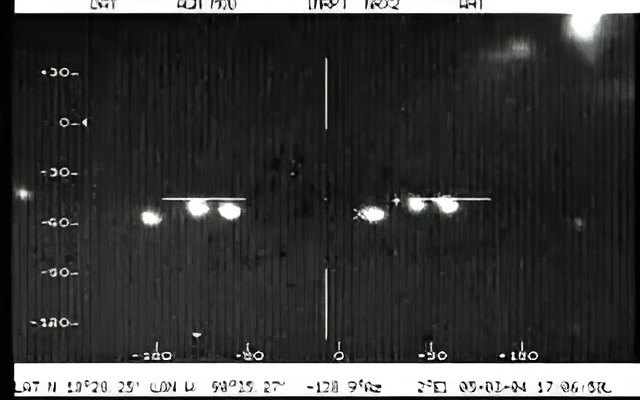
A Mexican Air Force Fairchild-Dornier Merlin C-26A of the 501st Air Squadron was flying an anti-drug patrol at about 10,500-11,500 ft over Campeche. Its Star Safire II infrared camera (FLIR) recorded a group of up to 11 bright thermal points, and its radar showed at least one target. Nobody aboard saw anything with the naked eye. In April 2004 the Secretaría de la Defensa Nacional (SEDENA) gave the tapes to journalist Jaime Maussan. On 11-12 May 2004 they were shown to the press, and Defence Secretary Gen. Clemente Vega García said he had no explanation. SEDENA has never published a formal technical report. What survives officially is the video, Vega's public statements and later freedom-of-information answers confirming SEDENA holds the record. From May 2004, independent analysts identified the lights as gas flares on the Cantarell oil platforms in the Bay of Campeche. That identification is supported by satellite fire data showing flaring on the day. It is the strongest prosaic explanation, but no official body has adopted or formally tested it.
Evidence, in date order (3)
- 22 Apr 2004SEDENA (Mexican Air Force)sensor datareleased the FLIR video of up to 11 thermal points Mirror copy of the SEDENA FLIR video (viewed)
- May 2004Gen. Clemente Vega García (Defence Secretary)officialpublicly said he had no explanation for the lights Patrick Gross, compilation of the May 2004 press and Maussan briefing
- SEDENA freedom-of-information answersofficialconfirm SEDENA holds the record La Razón, on SEDENA's position and the Maussan release
How plausible · Moderate
The Mexican military released its own FLIR footage with radar data and the Defence Secretary had no explanation; oil flares are proposed for the lights.
- ●●Access Air Force crew on sensors.
- ●●Character record Named military crew.
- ●●Checkable details check out Released footage.
- ●●Physical traces or official reaction FLIR and radar.
- ●○No gain sought Released via Maussan.
- ●○Independent convergence Radar and FLIR.
- −Lone source, no corroboration Crew accounts reach us through one presenter.
Plausibility weighs how well an account fits where secrecy hides the documents by design, so missing records never count against it. Strength measures what is documented. Assessed 2026-10-23.
On the record
- The aircraft was a Merlin C-26A, 501st Air Squadron, on a counter-narcotics patrol. Its sensors were a Star Safire II FLIR and a radar (reported as AN/APS-143). This comes from the crew briefing as compiled by Gross (secondhand), and the video confirms an IR sensor record.
- The FLIR shows a group of bright point sources that change in number and arrangement. The crew saw nothing visually. This is from the video plus the crew statements (secondhand).
- SEDENA itself released the tapes, and the Defence Secretary publicly said he had no hypothesis. These are the official statements (as quoted in the press): "I have no hypothesis. All I can say is that those white spots are there". On the drug-flight idea: "I thought that with the amount of drug traffic in the southeast, these could be drug-carrying aircraft."
- A meteorologist at the Servicio Meteorológico Nacional, Alberto Hernández Unzón, said there were no conditions for lightning or ball lightning that day. This is via Gross's compilation of May 2004 press (secondhand).
Claims
Where
Similar cases · sharing people, threads, topics or era
Connected cases
Threads · click one to see it on the board
Sources
- SEDENA (archive landing; no case page)
- Mirror copy of the SEDENA FLIR video (viewed)
- Patrick Gross, compilation of the May 2004 press and Maussan briefing
- Metabunk, "Mexican Air Force UFO Video? [Oil Rigs]"
- James C. Smith, eSkeptic, 24 Jul 2004 (not read; blocked)
- La Razón, on SEDENA's position and the Maussan release