2019 · Saturn's rings
How old are Saturn's rings?
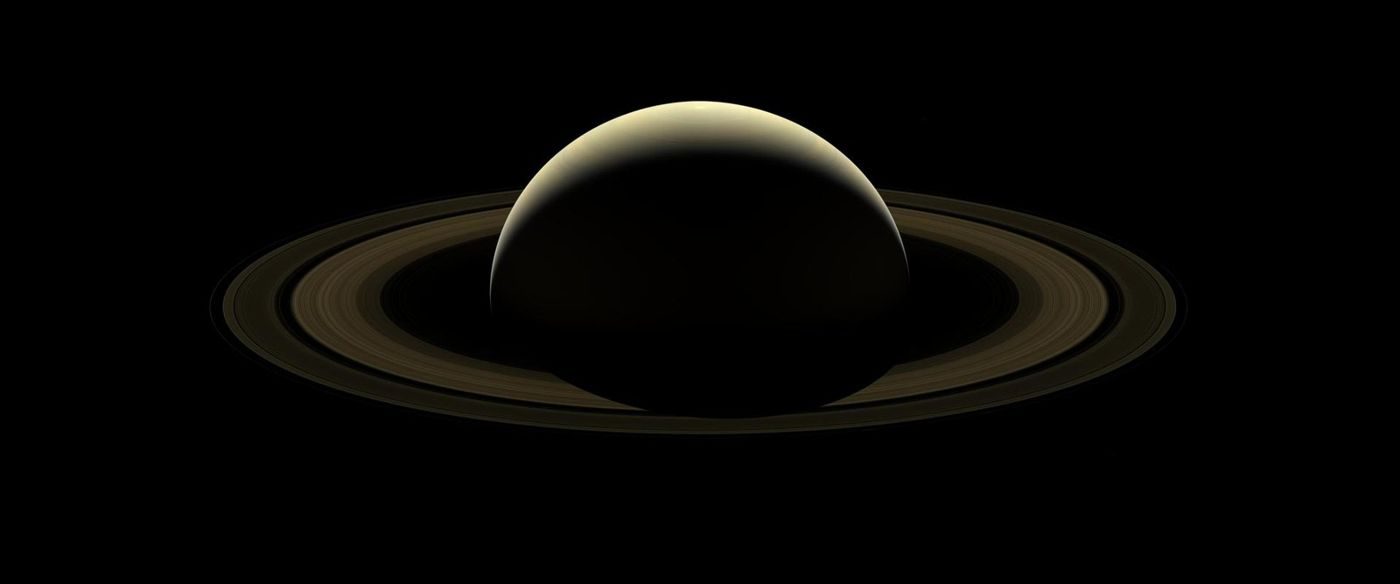
Saturn and its full ring system in one of Cassini's last mosaics, taken 13 September 2017 (PIA17218). · NASA/JPL-Caltech/Space Science Institute
When2019 – 2024 (Cassini analyses)
WhereSaturn's rings
Cassini's last orbits weighed the rings and found them light, which suggested they are young, perhaps 10 to 100 million years old; a 2023 dust study capped them at about 400 million years. A 2024 study argued the opposite, that the rings could be as old as the solar system. Nobody knows how they formed, and ring rain shows they are slowly being lost. This is the live scientific puzzle behind Bergrun's claim that the rings are made and maintained.
How plausible · Very high
The conflicting ages all come from peer-reviewed Cassini analyses; the open question is real.
- ●●Access Measured by Cassini's gravity and dust instruments.
- ●●No gain sought Published science; nobody is selling it.
- ●●Consistent over time The observation itself is not disputed.
- ●●Restraint Causes are labelled as proposed, not demonstrated.
- ●●Character record Peer-reviewed teams.
- ●●Independent convergence Iess 2019, Kempf 2023 and Hyodo 2024 are independent teams.
Plausibility weighs how well an account fits where secrecy hides the documents by design, so missing records never count against it. Strength measures what is documented. Assessed 2026-10-23.
Claims
Cassini Grand Finale gravity data: the rings are low-mass and probably 10 to 100 million years old.firsthandOn the recordIess et al. (2019, Science 364, eaat2965)
From how slowly they've been darkened by dust, the rings are no more than about 400 million years old.firsthandOn the recordKempf et al. (2023, Science Advances)
Impacting dust vaporises rather than sticking, so the rings could be as old as the solar system.firsthandOn the recordHyodo, Genda and Madeira (2024, Nature Geoscience)
'We still don't know how these rings formed in the first place.'firsthandOn the recordSascha Kempf
Ring material falls into Saturn along magnetic field lines, so the rings are being lost; if they persist, something replenishes them.firsthandOn the recordO'Donoghue et al. (2013, Nature)
Formation by a destroyed moon, colliding icy moons, or the lost moon 'Chrysalis'. Natural cause proposed, not demonstrated.analysisSourced, unconfirmedCanup (2010); Wisdom et al. (2022, Science)
‹ Previous in Saturn's RingmakersTowers at the edge of Saturn's B ring (2009 equinox)5 of 5
Similar cases · sharing people, threads, topics or era
Connected cases
Bergrun's ring vehicles in the Voyager plates 1980Towers at the edge of Saturn's B ring (2009 equinox) 2009